

How to Start with AI Engineering in end of 2025
A Clear, Practical Hands-on Roadmap


Hey there👋 ,
Welcome to a special edition of “The Mother of AI Project” series.
If you’ve been thinking about getting serious with AI engineering but were unsure where to start or what to build, this is the guide you read, save, and keep referring back to.
Share with others:
Where Should You Actually Start With AI Engineering?
The biggest challenge for most learners isn’t lack of resources, it’s lack of order.

Most people start by jumping between:
LLM tutorials
Transformers articles
LangChain experiments
vector database videos
fine-tuning guides
random open-source agents
too-early MLOps content
This leads to confusion, burnout, and zero end-to-end systems.
So here’s the direct, honest answer:
The strongest, most efficient starting point for AI engineering today is RAG.
Not Transformers.
Not LangChain.
Not prompting.
Not Agents.
RAG - Retrieval-Augmented Generation.
Let’s break down why.
Why Start with RAG (and Not LLMs or Agents)?
RAG forces you to learn AI the way it is practiced in real companies: through systems, infrastructure, retrieval, indexing, and deployment. This makes it the highest-leverage entry point.
Here are the key reasons.
1. RAG teaches the real engineering layer of AI systems.
LLM usage alone mostly teaches how to write prompts and manage tokens.
A proper RAG system forces you to understand:
Ingestion and parsing
ETL pipelines
OCR and PDF processing
Embeddings and indexing
Hybrid search (BM25 + vectors)
FastAPI service layers
Dockerized microservices
Chunking strategies
Caching
Observability and logging
Container orchestration
Deployment and environment management
Real debugging under constraints
This is what companies hire AI engineers for.
2. RAG is fundamentally an Information Retrieval problem - which teaches Search + Recommendations.
This is the part no one tells beginners:
RAG is built on the same foundations as:
Google Search
YouTube recommendations
Amazon and Netflix ranking
Enterprise document search
Internal knowledge systems
Content recommendation engines
By building RAG systems, you learn:
how queries are interpreted
ranking and scoring (BM25, vector similarity)
metadata filtering
semantic similarity
hybrid retrieval
chunk-level relevance scoring
evaluation metrics like nDCG-style thinking
This directly prepares you for:
search engineering
retrieval pipelines
recommendation systems
personalized AI
hybrid ranking systems
RAG quietly builds the foundations of two of the most valuable applied ML domains.
3. RAG naturally exposes you to LLMs, Transformers, MLOps, and Agents - through real use-cases.
You learn:
how LLMs hallucinate
how context windows behave
how embeddings are generated
intuition behind attention and tokenization
pipeline orchestration
error handling and fallbacks
monitoring and logging
multi-step reasoning workflows
Not theoretically! but through actual systems you build.
4. Most real AI products today follow this sequence:
Search → RAG → Agentic Layer
Across enterprise AI products:
knowledge assistants
customer support systems
internal research tools
document intelligence
domain-specific chat systems
enterprise copilots
Many rely on RAG at their core.
Mastering RAG means you are aligned with the modern AI stack.
5. RAG enables real, portfolio-worthy systems - fast!
Within weeks, you can build:
a private local assistant
a document search engine
a semantic Q&A system
a research assistant over academic papers
a Telegram AI bot with RAG backend
a production-style retrieval system
These are meaningful, career-changing projects.
Your AI Engineering Roadmap for 2025
(Entering 2026 Strong)
Assuming you know Python, here is the exact path we recommend.
Clear, practical, and aligned with real-world systems.
Step 1 - Understand the Fundamentals of RAG (2 hours)
Build the mental model:

why LLMs hallucinate
why retrieval fixes this
keyword search vs vector search
how hybrid search works
what “context” truly means
how a RAG pipeline flows end-to-end
Start here:

Step 2 - Build Your First Local Private RAG (3 days)
This is your first complete system.
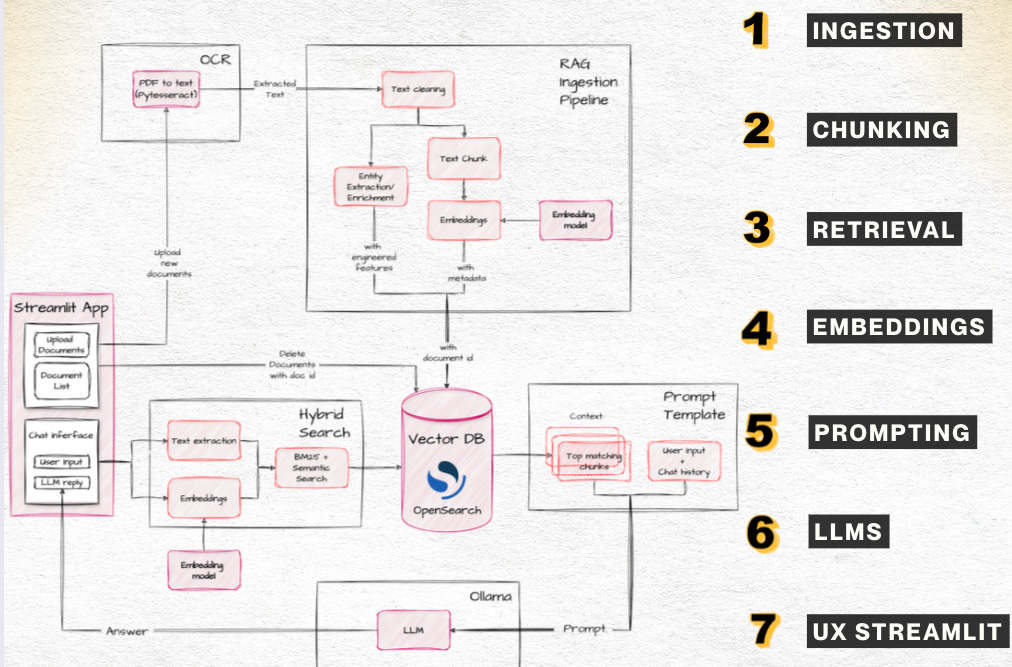
It teaches nearly everything you need at an entry level:
parsing your own PDFs
OCR with fallback
embedding generation
chunking and segmentation
OpenSearch hybrid retrieval
local LLM inference with Ollama
a Streamlit UI
Dockerized setup
Use:
Part 1:
Part 2:
Repository: https://github.com/jamwithai/local-rag-system
With Notebooks and detailed explanations of:


This one project already puts you ahead of 90% of beginners.
Step 3 - Build a Production-Grade RAG Pipeline (6 weeks)
A structured 6-week path that mirrors real engineering work
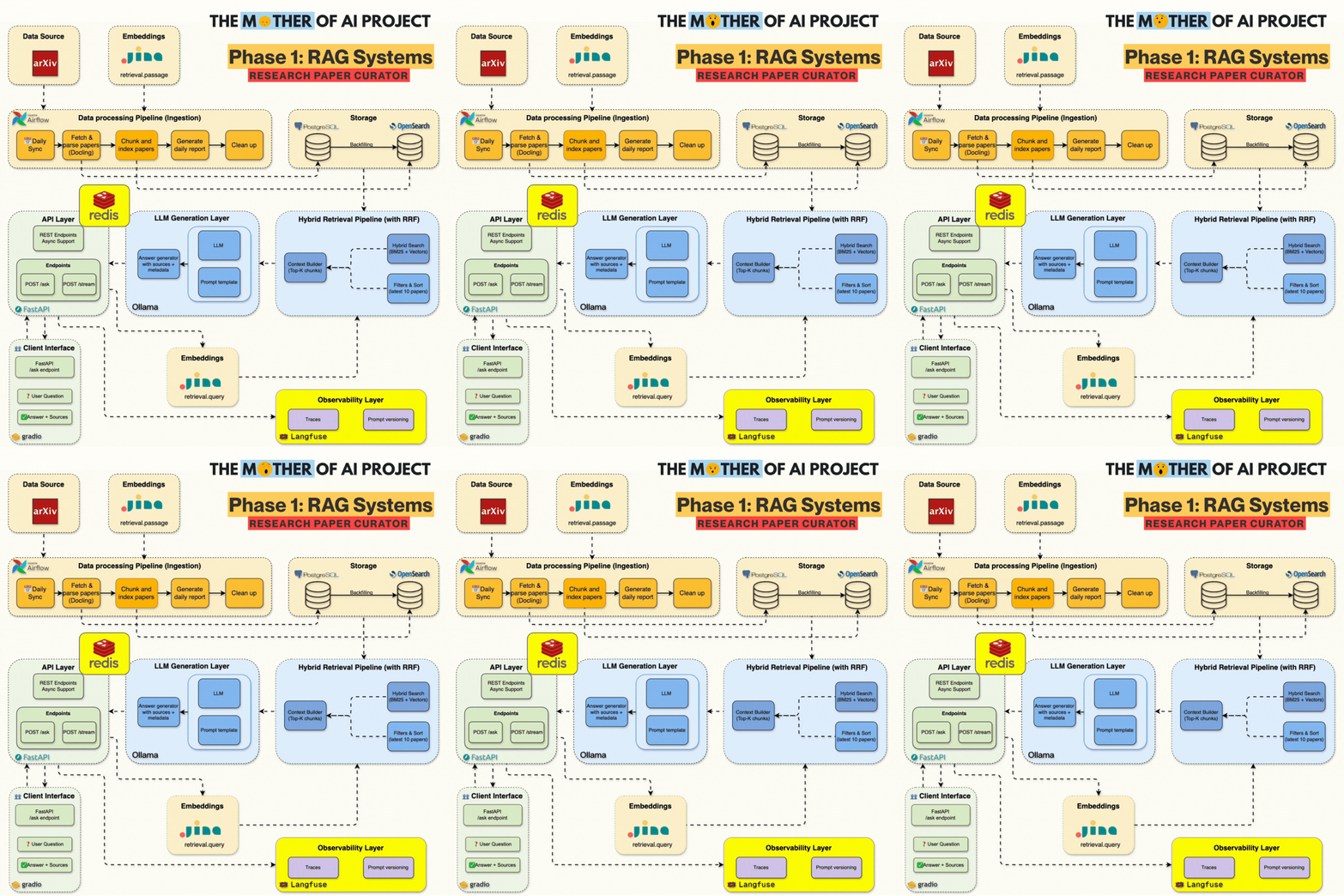
This is your first serious system:
ingestion via Airflow
arXiv API client with rate limiting
Docling-powered PDF parsing
metadata storage (PostgreSQL)
content indexing (OpenSearch)
BM25 + vector + hybrid retrieval
Jina embeddings
section-aware chunking
FastAPI backend
Gradio interface
Langfuse observability
Redis caching
Start here:

Code:
Breakdown:
Week 1 - Infrastructure
Week 2 - Data ingestion
Week 3 - Search foundations
Week 4 - Chunking + hybrid retrieval
Week 5 - Full RAG + LLM
Week 6 - Monitoring + caching
This prepares you for the systems companies are building today.
Step 4 - Move to Advanced Territory: Agentic RAG (2 days)
Once you master RAG, you can step into intelligent systems:
query validation
document grading
multi-step retrieval
intelligent fallback strategies
LangGraph orchestration
Telegram integration
adaptive search strategies
Start with:

This is where you start working like an advanced AI engineer.
Final Thoughts - Use the End of 2025 Intentionally
We are at the end of 2025.
This is the moment where many people reflect on their year and decide what to change in the next one.
You have two options:
Keep consuming scattered content, waiting for clarity to appear someday
or
Commit to one clear, structured path that genuinely builds your ability to design and ship AI systems
You do not need to learn everything.
You do not need perfect math.
You do not need a research background.
You need:
one strong starting point
one real system
one direction
consistent building
RAG gives you that foundation.
It teaches search, retrieval, recommendations, embeddings, system design, LLM integration, monitoring, caching, and agent readiness - all in one integrated journey.
If you start this path now, by beginning of 2026 you can be a completely different engineer.
And then you will continue with us on AI Agent journey!!!
Your future self will thank you for making this decision at the right time.
Let’s build with intention 💪
As an aspiring AI engineer I really loved this article❤️
Soooo much clarity!!!❤️
"RAG Systems self-paced course (with Discord support)" Do I need to purchase this one even if I go for the substack paid subscription?